



 888-568-1230
Fast Lead Times | Fast Shipping




 Fiber Optic Termination Tutorial
We terminate fiber optic cable two ways - with connectors that can mate two fibers to create a temporary joint and/or connect the fiber to a piece of network gear or with splices which create a permanent joint between the two fibers. These terminations must be of the right style, installed in a manner that makes them have little light loss and protected against dirt or damage in use. No area of fiber optics has been given greater attention than termination. Manufacturers have come up with over 80 styles of connectors and and about a dozen ways to install them. There are two types of splices and many ways of implementing the splice. Fortunately for me and you, only a few types are used most applications. Different connectors and splice termination procedures are used for singlemode and multimode connectors, so make sure you know what the fiber will be before you specify connectors or splices! For our customers, we sell pre-terminated fiber optic cables so they are able to connect them in their installation more easily.
Connectors
We'll start our section on termination by considering connectors. Since fiber optic technology was introduced in the late 70s, numerous connector styles have been developed. Each new design was meant to offer better performance (less light loss and back reflection), easier and/or termination and lower cost. Of course, the marketplace determines which connectors are ultimately successful.
Connector and Splice Loss Mechanisms
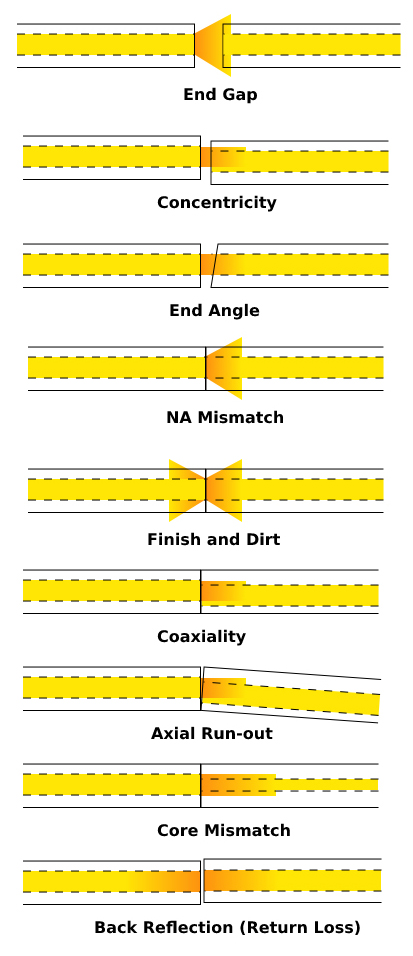
Connector and splice loss is caused by a number of factors. Loss is minimized when the two fiber cores are identical and perfectly aligned, the connectors or splices are properly finished and no dirt is present. Only the light that is coupled into the receiving fiber's core will propagate, so all the rest of the light becomes the connector or splice loss.
End gaps cause two problems, insertion loss and return loss. The emerging cone of light from the connector will spill over the core of the receiving fiber and be lost. In addition, the air gap between the fibers causes a reflection when the light encounters the change n refractive index from the glass fiber to the air in the gap. This reflection (called fresnel reflection) amounts to about 5% in typical flat polished connectors, and means that no connector with an air gap can have less than 0.3 dB loss. This reflection is also referred to as back reflection or optical return loss, which can be a problem in laser based systems. Connectors use a number of polishing techniques to insure physical contact of the fiber ends to minimize back reflection. On mechanical splices, it is possible to reduce back reflection by using non-perpendicular cleaves, which cause back reflections to be absorbed in the cladding of the fiber.
The end finish of the fiber must be properly polished to minimize loss. A rough surface will scatter light and dirt can scatter and absorb light. Since the optical fiber is so small, typical airborne dirt can be a major source of loss. Whenever connectors are not terminated, they should be covered to protect the end of the ferrule from dirt. One should never touch the end of the ferrule, since the oils on one's skin causes the fiber to attract dirt. Before connection and testing, it is advisable to clean connectors with lint-free wipes moistened with isopropyl alcohol.
Two sources of loss are directional; numerical aperture (NA) and core diameter. Differences in these two will create connections that have different losses depending on the direction of light propagation. Light from a fiber with a larger NA will be more sensitive to angularity and end gap, so transmission from a fiber of larger NA to one of smaller NA will be higher loss than the reverse. Likewise, light from a larger fiber will have high loss coupled to a fiber of smaller diameter, while one can couple a small diameter fiber to a large diameter fiber with minimal loss, since it is much less sensitive to end gap or lateral offset.
These fiber mismatches occur for two reasons. The occasional need to interconnect two dissimilar fibers and production variances in fibers of the same nominal dimensions. With two multimode fibers in usage today and two others which have been used occasionally in the past and several types of singlemode fiber in use, it is possible to sometimes have to connect dissimilar fibers or use systems designed for one fiber on another. Some system manufacturers provide guidelines on using various fibers, some don't. If you connect a smaller fiber to a larger one, the coupling losses will be minimal, often only the fresnel loss (about 0.3 dB). But connecting larger fibers to smaller ones results in substantial losses, not only due to the smaller cores size, but also the smaller NA of most small core fibers.
Guide to Fiber Optic Connectors
Check out the "spotters guide" below and you will see the most common fiber optic connectors. (All the photos are to the same scale, so you can get an idea of the relative size of these connectors.)
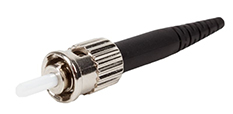
ST (an AT&T Trademark) is the most popular connector for multimode networks, like most buildings and campuses. It has a bayonet mount and a long cylindrical ferrule to hold the fiber. Most ferrules are ceramic, but some are metal or plastic. And because they are spring-loaded, you have to make sure they are seated properly. If you have high loss, reconnect them to see if it makes a difference.
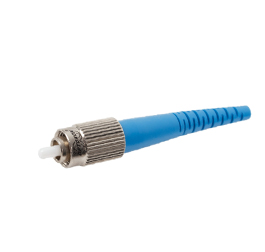
FC/PC has been one of the most popular singlemode connectors for many years. It screws on firmly, but make sure you have the key aligned in the slot properly before tightening. It's being replaced by SCs and LCs.
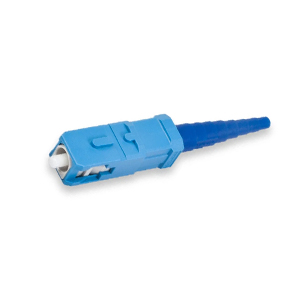
SC is a snap-in connector that is widely used in singlemode systems for it's excellent performance. It's a snap-in connector that latches with a simple push-pull motion. It is also available in a duplex configuration.
Besides the SC Duplex, you may occasionally see the FDDI and ESCON* duplex connectors which mate to their specific networks. They are generally used to connect to the equipment from a wall outlet, but the rest of the network will have ST or SC connectors. *ESCON is an IBM trademark
Below are some of the new Small Form Factor (SFF) connectors:
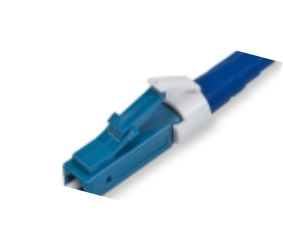
LC is a new connector that uses a 1.25 mm ferrule, half the size of the ST. Otherwise, it's a standard ceramic ferrule connector, easily terminated with any adhesive. Good performance, highly favored for singlemode.
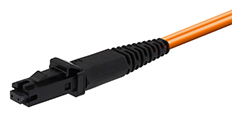
MT-RJ is a duplex connector with both fibers in a single polymer ferrule. It uses pins for alignment and has male and female versions. Multimode only, field terminated only by prepolished/splice method.
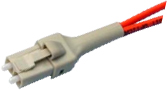
Opti-Jack is a neat, rugged duplex connector cleverly designed aournd two ST-type ferrules in a package the size of a RJ-45. It has male and female (plug and jack) versions.
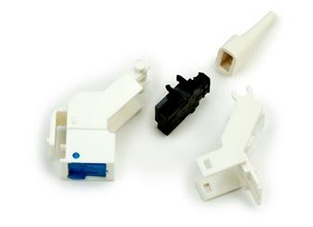
Volition is a slick, inexpensive duplex connector that uses no ferrule at all. It aligns fibers in a V-groove like a splice. Plug and jack versions, but field terminate jacks only.
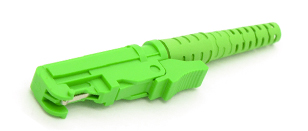
E2000/LX-5 is like a LC but with a shutter over the end of the fiber.
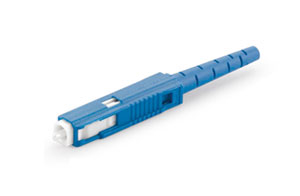
MU looks a miniature SC with a 1.25 mm ferrule. It's more popular in Japan.
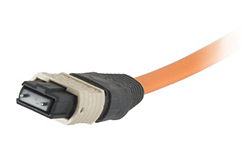
MT is a 12 fiber connector for ribbon cable. It's main use is for preterminated cable assemblies.
The ST/SC/FC/FDDI/ESON connectors have the same ferrule size - 2.5 mm or about 0.1 inch - so they can be mixed and matched to each other using hybrid mating adapters. This makes it convenient to test, since you can have a set of multimode reference test cables with ST connectors and adapt to all these connectors. Likewise, the LC, MU and E2000/LX-5 use the same ferrule but cross-mating adapters are not easy to find.
Connector Types
The ST is still the most popular multimode connector because it is cheap and easy to install. The SC connector was specified as a standard by the old EIA/TIA 568A specification, but its higher cost and difficulty of installation (until recently) has limited its popularity. However, newer SCs are much better in both cost and installation ease, so it has been growing in use. The duplex FDDI, ESCON and SC connectors are used for patchcords to equipment and can be mated to ST or SC connectors at wall outlets. Singlemode networks use FC or SC connectors in about the same proportion as ST and SC in multimode installations. There are some D4s out there too.
EIA/TIA 568 B allows any fiber optic connector as long as it has a FOCIS (Fiber Optic Connector Intermateability Standard) document behind it. This opened the way to the use of several new connectors, which we call the "Small Form Factor" (SFF) connectors, including AT&T LC, the MT-RJ, the Panduit "Opti-Jack," 3M's Volition, the E2000/LX-5 and MU. The LC has been particularly successful in the US.
Connector Ferrule Shapes & Polishes
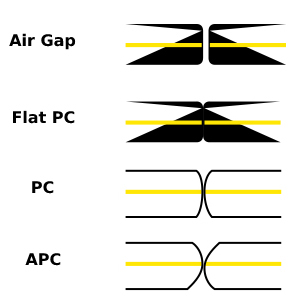
Fiber optic connectors can have several different ferrule shapes or finishes, usually referred to as polishes. early connectors, because they did not have keyed ferrules and could rotate in mating adapters, always had an air gap between the connectors to prevent them rotating and grinding scratches into the ends of the fibers.
Beginning with the ST and FC which had keyed ferrules, the connectors were designed to contact tightly, what we now call physical contact (PC) connectors. Reducing the air gap reduced the loss and back reflection (very important to laser-based singlemode systems ), since light has a loss of about 5% (~0.25 dB) at each air gap and light is reflected back up the fiber. While air gap connectors usually had losses of 0.5 dB or more and return loss of 20 dB, PC connectors had typical losses of 0.3 dB and a return loss of 30 to 40 dB.
Soon thereafter, it was determined that making the connector ferrules convex would produce an even better connection. The convex ferrule guaranteed the fiber cores were in contact. Losses were under 0.3dB and return loss 40 dB or better. The final solution for singlemode systems extremely sensitive to reflections, like CATV or high bitrate telco links, was to angle the end of the ferrule 8 degrees to create what we call an APC or angled PC connector. Then any reflected light is at an angle that is absorbed in the cladding of the fiber.
Termination Procedures
Whatever you do, follow the manufacturer's termination instructions closely. Multimode connectors are usually installed in the field on the cables after pulling, while singlemode connectors are usually installed by splicing a factory-made "pigtail" onto the fiber. That is because the tolerances on singlemode terminations are much tighter and the polishing processes are more critical. You can install singlemode connectors in the field for low speed data networks, but you may not be able to get losses lower than 1 dB! Cables can be pulled with connectors already on them if, and a big if, you can deal with these two problems: First, the length must be precise. Too short and you have to pull another longer one (its not cost effective to splice), too long and you waste money and have to store the extra cable length. Secondly, the connectors must be protected. Some cable and connector manufacturers offer protective sleeves to cover the connectors, but you must still be much more careful in pulling cables. You might consider terminating one end and pulling the unterminated end to not risk the connectors.
There is a growing movement to install preterminated systems but with the MT 12 multifiber connector. It's tiny not much bigger than a ST or SC, but has up to 12 fibers. Manufactures sell multifiber cables with MTs on them that connect to preterminated patch panels with STs or SCs. Works well if you have a good designer and can live with the higher loss (~1 dB) typical of these connectors.
Multimode Terminations: Several different types of terminations are available for multimode fibers. Each version has its advantages and disadvantages, so learning more about how each works helps decide which one to use.
A note on adhesives: Most connectors use epoxies or other adhesives to hold the fiber in the connector. Use only the specified epoxy, as the fiber to ferrule bond is critical for low loss and long term reliability! We've seen people use hardware store epoxies, Crazy Glue, you name it! And they regretted doing it.
Epoxy/Polish: Most connectors are the simple "epoxy/polish" type where the fiber is glued into the connector with epoxy and the end polished with special polishing film. These provide the most reliable connection, lowest losses (less than 0.5 dB) and lowest costs, especially if you are doing a lot of connectors. The epoxy can be allowed to set overnight or cured in an inexpensive oven. A "heat gun" should never be used to try to cure the epoxy faster as the uneven heat may not cure all the epoxy or may overheat some of it which will prevent it ever curing!
"Hot Melt": This is a 3M trade name for a connector that already has the epoxy (actually a heat set glue) inside the connector. You strip the cable, insert it in the connector, crimp it, and put it in a special oven. In a few minutes, the glue is melted, so you remove the connector, let it cool and it is ready to polish. Fast and easy, low loss, but not as cheap as the epoxy type, it has become the favorite of lots of contractors who install relatively small quantities of connectors.
Anaerobic Adhesives: These connectors use a quick setting adhesive to replace the epoxy. They work well if your technique is good, but often they do not have the wide temperature range of epoxies, so only use them indoors. A lot of installers are using Loctite 648, with or without the accellerator solution, that is neat and easy to use.
Crimp/Polish: Rather than glue the fiber in the connector, these connectors use a crimp on the fiber to hold it in. Early types offered "iffy" performance, but today they are pretty good, if you practice a lot. Expect to trade higher losses for the faster termination speed. And they are more costly than epoxy polish types. A good choice if you only install small quantities and your customer will accept them.
Prepolished/splice: Some manufacturers offer connectors that have a short stub fiber already epoxied into the ferrule and polished perfectly, so you just cleave a fiber and insert it like a splice. (See next section for splicing info.) While it sound like a great idea, it has several downsides. First it is very costly, five to ten times as much as an epoxy polish type. Second, you have to make a good cleave to make them low loss, and that is not as easy as you might think. Third, even if you do everything correctly, you loss will be higher, because you have a connector loss plus two splice losses at every connection! The best way to terminate them is to monitor the loss with a visual fault locator and "tweak" them.
Field Termination vs. Pre-Termination: Choosing the Right Approach for your Fiber Optic Needs
Ensuring a reliable and high-performance connection hinges on the termination process. But with two main options – field termination and pre-termination – selecting the most suitable method can be crucial. Let's delve into the key differences and help you decide which approach best suits your project.
Field Termination:
-
Customization: Offers superior flexibility, allowing for on-site cable tailoring to specific lengths. This is ideal for scenarios where precise measurements are difficult beforehand or frequent adjustments are anticipated.
-
Technical Expertise: Requires trained technicians equipped with specialized tools and equipment for proper termination and testing. Improper installation can lead to signal degradation and performance issues.
-
Time Consumption: The process can be time-consuming, especially for complex installations, potentially impacting project timelines.
Pre-Termination:
-
Convenience and Speed: Cables arrive pre-assembled with connectors, eliminating the need for field termination. This translates to faster installation times and reduced labor costs.
-
Quality Assurance: Factory-controlled environment ensures consistent quality and minimizes the risk of human error during termination. Pre-terminated cables typically undergo rigorous testing for optimal performance.
-
Limited Flexibility: Cable lengths are predetermined, requiring accurate measurements during the planning stage. Inaccurate measurements can result in insufficient cable length or unnecessary waste.
Choosing the Right Method:
-
Project Requirements: If your project demands precise cable lengths or frequent adjustments, field termination might be the way to go.
-
Technical Expertise: For situations where skilled technicians and specialized tools are readily available, field termination can be a viable option.
-
Time Constraints: Pre-terminated cables offer a significant advantage for time-sensitive projects as they require minimal on-site setup.
-
Budget: While pre-terminated cables may have a slightly higher upfront cost, the trade-off in terms of faster installation and potentially lower labor expenses needs to be considered.
By understanding the strengths and limitations of each approach, you can make an informed decision that aligns with your project's specific requirements, ensuring a successful and efficient fiber optic installation.
Hints for doing field terminations
Here are a few things to remember when you are terminating connectors in the field. Following these guidelines will save you time, money and frustration:
Choose the connector carefully and clear it with the customer if it is anything other than an epoxy/polish type. Some customers have strong opinions on the types or brands of connectors used in their job. Find out first, not later!
Never, never, NEVER take a new connector in the field until you have installed enough of them in the office that you can put them on in your sleep. The field is no place to experiment or learn! It'll cost you big time!
Have the right tools for the job. Make sure you have the proper tools and they are in good shape before you head out for the job. This includes all the termination tools, cable tools and test equipment. Do you know your test cables are good? Without that, you will test good terminations as bad every time. More and more installers are owning their own tools like auto mechanics, saying that is the only way to make sure the tools are properly cared for.
Dust and dirt are your enemies. It's very hard to terminate or splice in a dusty place. Try to work in the cleanest possible location. Use lint-free wipes (not cotton swaps or rags made from old T-shirts!) to clean every connector before connecting or testing it. Don't work under heating vents, as they are blowing dirt down on you continuously.
Don't overpolish. Contrary to common sense, too much polishing is just as bad as too little. The ceramic ferrule in most of today's connector is much harder than the glass fiber. Polish too much and you create a concave fiber surface, increasing the loss. A few swipes is all it takes.
Remember singlemode fiber requires different connectors and polishing techniques. Most SM fiber is terminated by splicing on a preterminated pigtail, but you can put SM connectors on in the field if you know what you are doing. Expect much higher loss, approaching 1 dB and high back reflections, so don't try it for anything but data networks, not telco or CATV.
Change polishing film regularly. Polishing builds up residue and dirt on the film that can cause problems after too many connectors and cause poor end finish. Check the manufacturers' specs.
Put covers on connectors and patch panels when not in use. Keep them covered to keep them clean.
Inspect and test, then document. It is very hard to troubleshoot cables when you don't know how long they are, where they go or how they tested originally! So keep good records, smart users require it and expect to pay extra for good records.
Splicing
Splicing is only needed if the cable runs are too long for one straight pull or you need to mix a number of different types of cables (like bringing a 48 fiber cable in and splicing it to six 8 fiber cables - could you have used a breakout cable instead?) And of course, we use splices for restoration, after the number one problem of outside plant cables, a dig-up and cut of a buried cable, usually referred to as "backhoe fade" for obvious reasons!
Splices are "permanent" connections between two fibers. There are two types of splices, fusion and mechanical, and the choice is usually based on cost or location. Most splicing is on long haul outside plant SM cables, not multimode LANs, so if you do outside plant SM jobs, you will want to learn how to fusion splice. If you do mostly MM LANs, you may never see a splice.
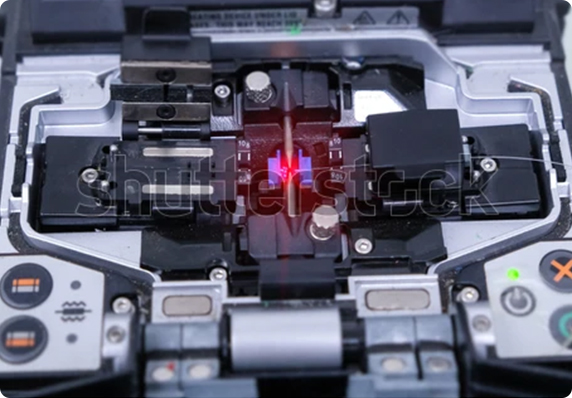
Fusion Splices are made by "welding" the two fibers together usually by an electric arc. Obviously, you don't do that in an explosive atmosphere (at least not more than once!), so fusion splicing is usually done above ground in a truck or trailer set up for the purpose. Good fusion splicers cost $15,000 to $40,000, but the splices only cost a few dollars each. Today's singlemode fusion splicers are automated and you have a hard time making a bad splice. The biggest application is singlemode fibers in outside plant installations.
Mechanical Splices are alignment gadgets that hold the ends of two fibers together with some index matching gel or glue between them. There are a number of types of mechanical splices, like little glass tubes or V-shaped metal clamps. The tools to make mechanical splices are cheap, but the splices themselves are expensive. Many mechanical splices are used for restoration, but they can work well with both singlemode and multimode fiber, with practice.
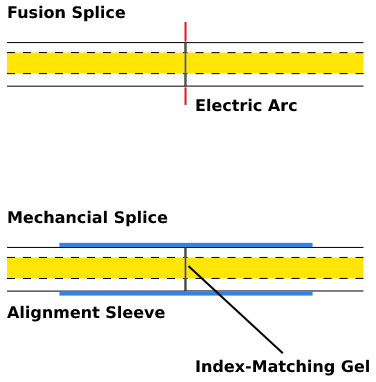
Which Splice?
If cost is the issue, we've given you the clues to make a choice: fusion is expensive equipment and cheap splices, while mechanical is cheap equipment and expensive splices. So if you make a lot of splices (like thousands in an big telco or CATV network) use fusion splices. If you need just a few, use mechanical splices. Fusion splices give very low back reflections and are preferred for singlemode high speed digital or CATV networks. However, they don't work too well on multimode splices, so mechanical splices are preferred for MM, unless it is an underwater or aerial application, where the greater reliability of the fusion splice is preferred.
Featured Fiber Optic Products

Read on for more fiber optic tutorial information..


We welcome you to link this page from your website; however, copying this article in whole or in part is strictly prohibited.
Disclaimer: We have provided this article as general installation advice to our customers. We make no claims about the completeness or the accuracy of the information as it may apply to an infinite amount of field conditions. It is the responsibility of the person or persons using this information to check with all concerned parties, owners and local authorities, etc. before doing an installation. Users of this information agree to hold Atcom Inc. harmless form liabilities of any kind relating to the use of this information.
