


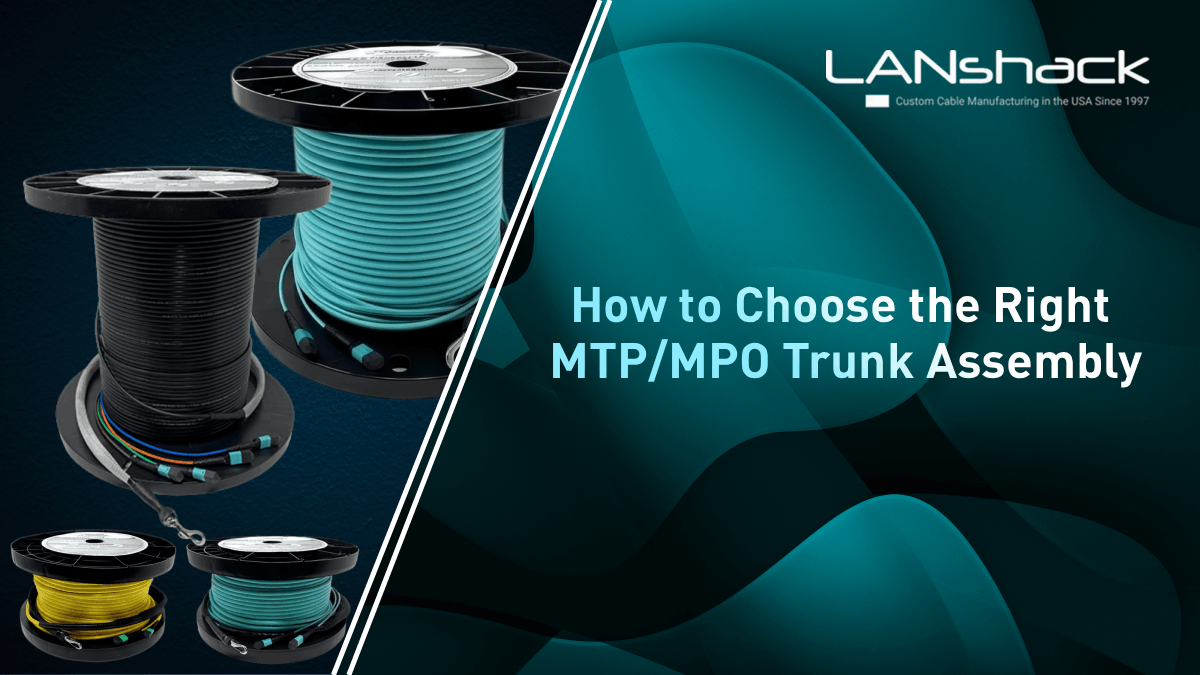


Choosing the right MTP/MPO trunk assembly depends on:
- fiber count requirements
- transmission distance
- deployment environment
- scalability goals
- network architecture
In high-density fiber environments, organizations commonly deploy pre-terminated MTP/MPO trunk assemblies ranging from 12-fiber to 288-fiber configurations to support backbone connectivity, simplify installation, and prepare for future growth.
The right trunk assembly often depends on:
- current bandwidth requirements
- future scalability plans
- singlemode vs multimode needs
- indoor or outdoor deployment conditions
- connector and polarity requirements
MTP/MPO Trunk Assembly at a Glance
| Feature | Typical Options |
| Fiber Counts | 12F, 24F, 48F, 72F, 96F, 144F, 288F |
| Fiber Types | Singlemode & Multimode |
| Deployment Types | Indoor, Indoor/Outdoor, Armored |
| Common Applications | Data centers, telecom, enterprise backbone |
| Connector Types | MTP® & MPO |
| Typical Use | High-density backbone connectivity |
What Is an MTP/MPO Trunk Assembly?
An MTP/MPO trunk assembly is a pre-terminated high-density fiber assembly designed to connect multiple fiber strands through one organized backbone cable.
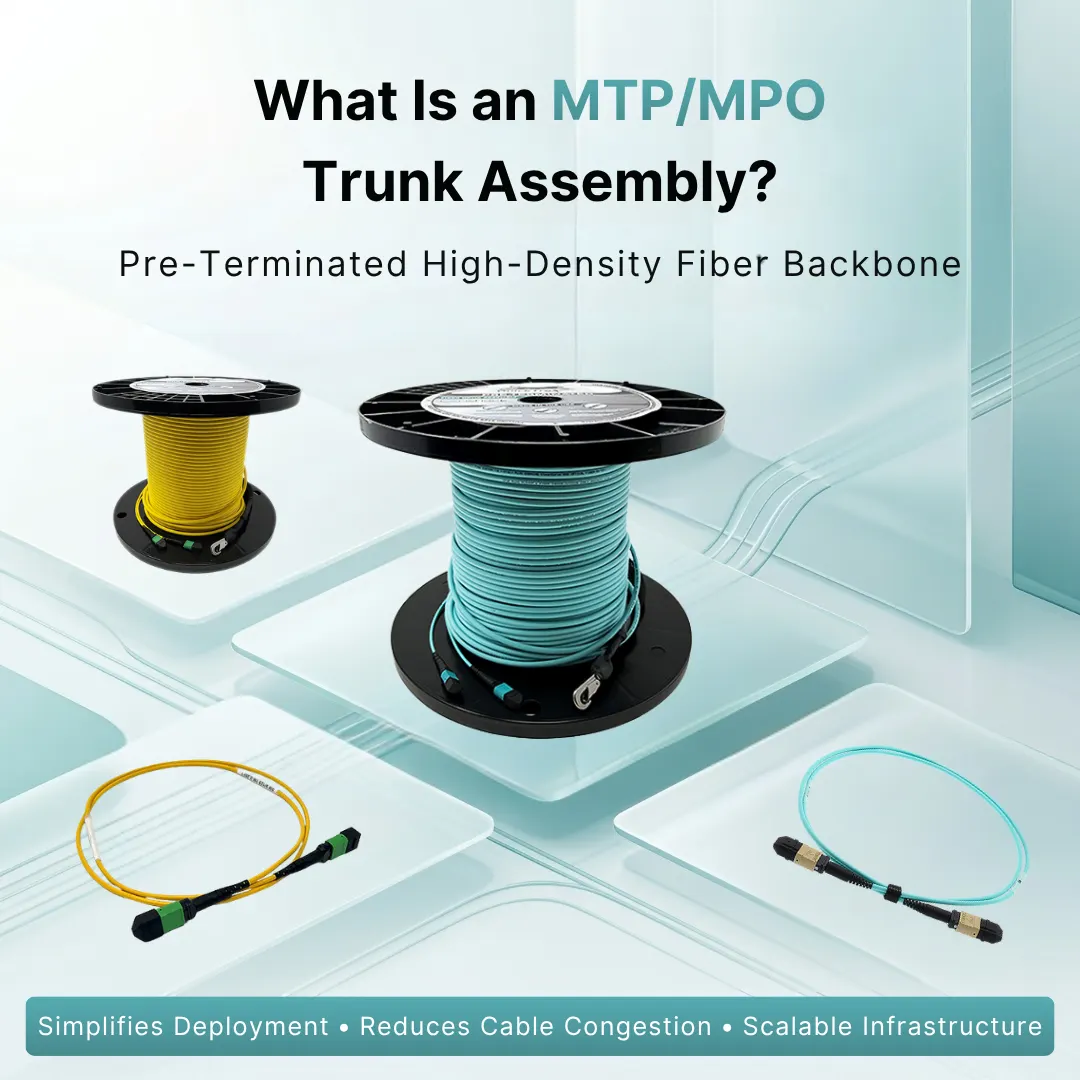
Rather than managing many separate fiber runs, organizations use trunk assemblies to simplify deployment, reduce cable congestion, and support scalable fiber infrastructure.
MTP/MPO trunk assemblies are commonly used in:
- data centers
- enterprise backbone networks
- telecom environments
- cloud and AI infrastructure
Depending on the environment, organizations may choose different fiber counts, cable constructions, and connector configurations to support current and future requirements.
Why Fiber Count Matters
One of the most important decisions when selecting an MTP/MPO trunk assembly is choosing the right fiber count.
Selecting too few fibers may limit future scalability, while overbuilding unnecessarily may increase cost and complexity.
In many high-density environments, organizations plan for:
- both current requirements and future growth
-
before selecting a trunk configuration
 Build a strong foundation with What Is MPO Cable? before evaluating assembly options.
Choosing the Right Fiber Count (12F-288F)
The right fiber count depends on current bandwidth requirements, expected growth, and infrastructure design.
12F Trunk Assemblies
Commonly used for:
- smaller backbone deployments
- point-to-point connectivity
- lower-density environments
- early network expansion
24F Trunk Assemblies
Often selected for:
- enterprise backbone growth
- moderate-density deployments
- growing telecom environments
24F configurations often balance scalability and deployment simplicity.
48F-72F Trunk Assemblies
Commonly used for:
- rack-to-rack infrastructure
- higher-capacity switching environments
- growing data center environments
These configurations are often selected when long-term scalability is a priority.
96F-144F Trunk Assemblies
Often deployed for:
- enterprise backbone infrastructure
- telecom distribution systems
- large-scale fiber aggregation
Organizations planning future expansion often evaluate higher fiber counts early.
288F Trunk Assemblies
Commonly used in:
- hyperscale environments
- carrier-grade infrastructure
- large data center deployments
- high-density backbone environments
Higher fiber counts can help maximize density while simplifying cable organization.
Understand the differences between the different connector typesSinglemode vs Multimode Considerations
Choosing the right fiber type matters as much as selecting the correct fiber count.
Singlemode
Often selected for:
- longer transmission distances
- telecom backbone environments
- building-to-building connectivity
Multimode
Commonly used for:
- rack-to-rack connectivity
- internal data center infrastructure
- localized high-density environments
Indoor, Indoor/Outdoor & Armored Considerations
Deployment environment also matters when selecting a trunk assembly.
Indoor Trunk Assemblies
Common in:
- data centers
- telecom rooms
- enterprise environments
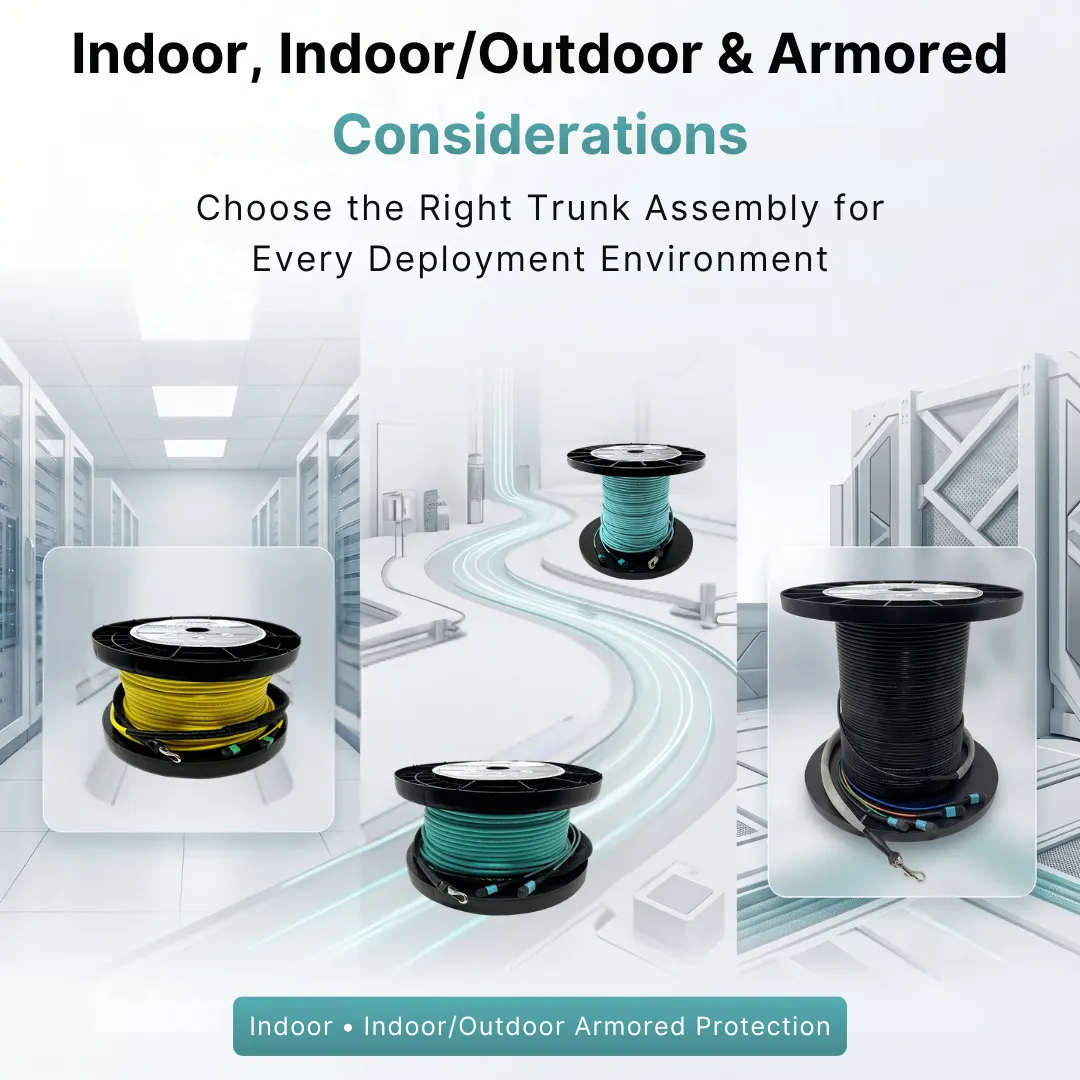
Indoor/Outdoor Assemblies
Often used when routes transition between different environments.
Armored Trunk Assemblies
Selected when additional cable protection is required.
Common MTP/MPO Trunk Assembly Selection Mistakes
Choosing Too Few Fibers
Selecting only for current requirements may limit future scalability.
Ignoring Deployment Environment
Indoor, outdoor, and armored assemblies are designed for different conditions.
Overlooking MTP/MPO Polarity
Incorrect polarity planning may create signal alignment challenges later.
Learn how connector polarity can influence network design decisions.Confusing MTP and MPO Requirements
Although compatible, connector selection may vary depending on deployment priorities.
How to Choose the Right MTP/MPO Trunk Assembly
Before selecting a trunk assembly, network teams often evaluate:
- fiber count requirements
- singlemode vs multimode needs
- deployment environment
- polarity requirements
- future scalability plans
- connector preferences
Choosing the right pre-terminated MTP/MPO trunk assembly early can help simplify installation while supporting long-term network growth.
Want More Detail? Explore What Is MTP Cable? to better understand MTP-based fiber assemblies.Frequently asked questions
Q1: What is an MTP/MPO trunk assembly?
An MTP/MPO trunk assembly is a pre-terminated high-density fiber assembly designed to connect multiple fiber strands through a single organized backbone cable.
Q2: What fiber count should I choose?
The right fiber count depends on current bandwidth needs, expected growth, deployment environment, and future scalability goals.
Q3: What is the difference between 12F and 24F trunk assemblies?
12F assemblies are often used for smaller deployments, while 24F configurations may support growing backbone requirements.
Q4: Are MTP/MPO trunk assemblies available in singlemode and multimode?
Yes. Organizations commonly choose between singlemode and multimode configurations depending on distance and infrastructure requirements.
Q5: Does polarity matter when choosing an MTP/MPO trunk assembly?
Yes. Incorrect polarity planning may create signal alignment problems later.
Q6: When should organizations choose higher fiber counts like 144F or 288F?
Higher fiber counts are commonly selected for high-density, telecom, carrier-grade, and large-scale infrastructure environments.