




An MTP cable is a high-density fiber optic connectivity solution that uses MTP® connectors to support multiple fiber strands through a single connection point for faster deployment and scalable high-bandwidth networking.
Developed by US Conec, MTP connectors are an enhanced version of standard MPO connectors, designed to improve alignment, reduce insertion loss, and support more reliable high-density fiber performance.
In modern deployments, pre-terminated MTP fiber assemblies are commonly used in data centers, enterprise backbone networks, telecom environments, and high-bandwidth infrastructure where scalability, reliability, and organized fiber management are important.
MTP Cable at a Glance
| Feature | MTP Fiber Assemblies |
| Primary Purpose | High-density fiber connectivity |
| Connector Type | MTP® (US Conec) |
| Typical Fiber Counts | 12F, 24F, 48F, 72F, 96F, 144F, 288F |
| Fiber Types | Singlemode & Multimode |
| Common Formats | Trunk assemblies, fanouts, breakout assemblies |
| Typical Environments | Data centers, telecom, enterprise networks |
| Key Benefit | Improved performance and scalability |
What Is MTP Cable?
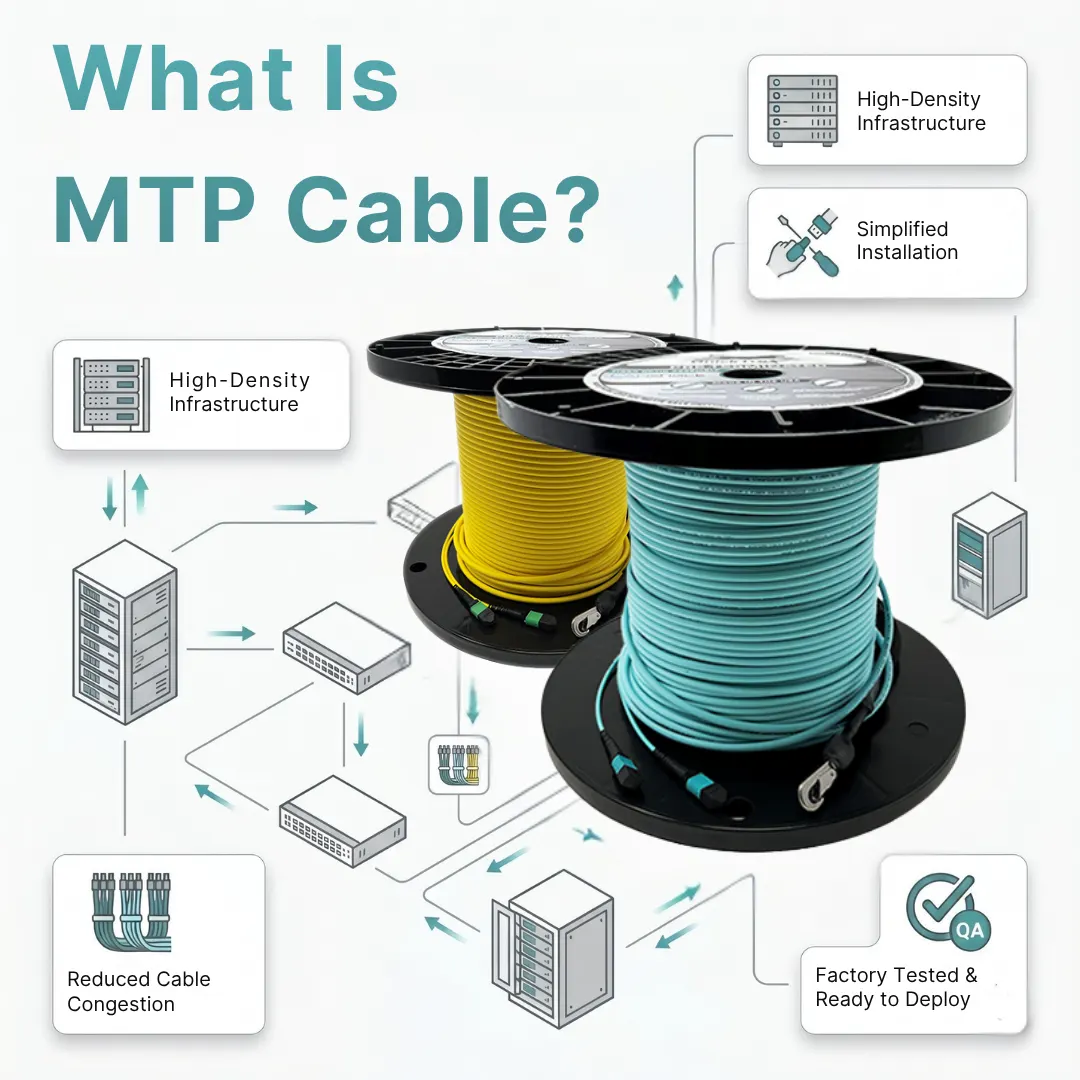
At a basic level, an MTP cable is a pre-terminated fiber assembly designed to support multiple optical fibers through an MTP connector interface.
Rather than deploying many separate fiber connections, organizations use MTP fiber assemblies to simplify installation, reduce cable congestion, and support high-density infrastructure more efficiently.
In many environments, MTP fiber assemblies are used as part of larger backbone fiber deployments, helping connect:
- network cabinets
- switches
- patching environments
- high-density rack systems
- telecommunications infrastructure
Because MTP assemblies are factory-terminated and tested before deployment, installation teams can often reduce field labor while improving deployment consistency.
How MTP Connectors Work
An MTP connector is designed to support multiple fiber strands inside one compact high-density interface.
Instead of connecting fibers individually, an MTP connector allows multiple fibers to be aligned and connected simultaneously, helping simplify high-density fiber deployment.
This approach can help improve:
- cable organization
- rack-to-rack connectivity
- deployment consistency
- backbone infrastructure scaling
Depending on deployment requirements, MTP fiber assemblies may support 12-fiber to 288-fiber high-density configurations.
MTP vs Standard MPO
Although often grouped together, MTP and MPO are not identical.
Standard MPO
MPO is the industry-standard multi-fiber connector format used in high-density fiber connectivity.
 New to Multi-Fiber Connectivity? Explore MPO Cable to understand the foundation behind MPO and MTP-based fiber infrastructure.
MTP®
MTP is a premium MPO connector developed by US Conec with enhancements such as:
- improved mechanical alignment
- lower insertion loss
- better durability
- easier insertion and removal
In simple terms:
All MTP connectors follow MPO standards, but MTP includes performance enhancements designed for demanding high-density environments.
Because of these advantages, many organizations choose MTP-based trunk assemblies for enterprise and data center deployments.
See how MTP differs from standard MPO designs in MTP vs MPOWhy Organizations Choose MTP Fiber Assemblies
Organizations often choose MTP fiber assemblies when they need to support high-density fiber connectivity without adding unnecessary installation complexity.
Compared to traditional multi-cable deployments, pre-terminated MTP assemblies can help simplify infrastructure while supporting future bandwidth growth.
Common reasons organizations choose MTP assemblies include:
- faster deployment timelines
- reduced cable congestion
- improved scalability
- factory-tested consistency
- simplified high-density connectivity
For many environments, MTP trunk assemblies help reduce installation time while supporting long-term infrastructure growth.
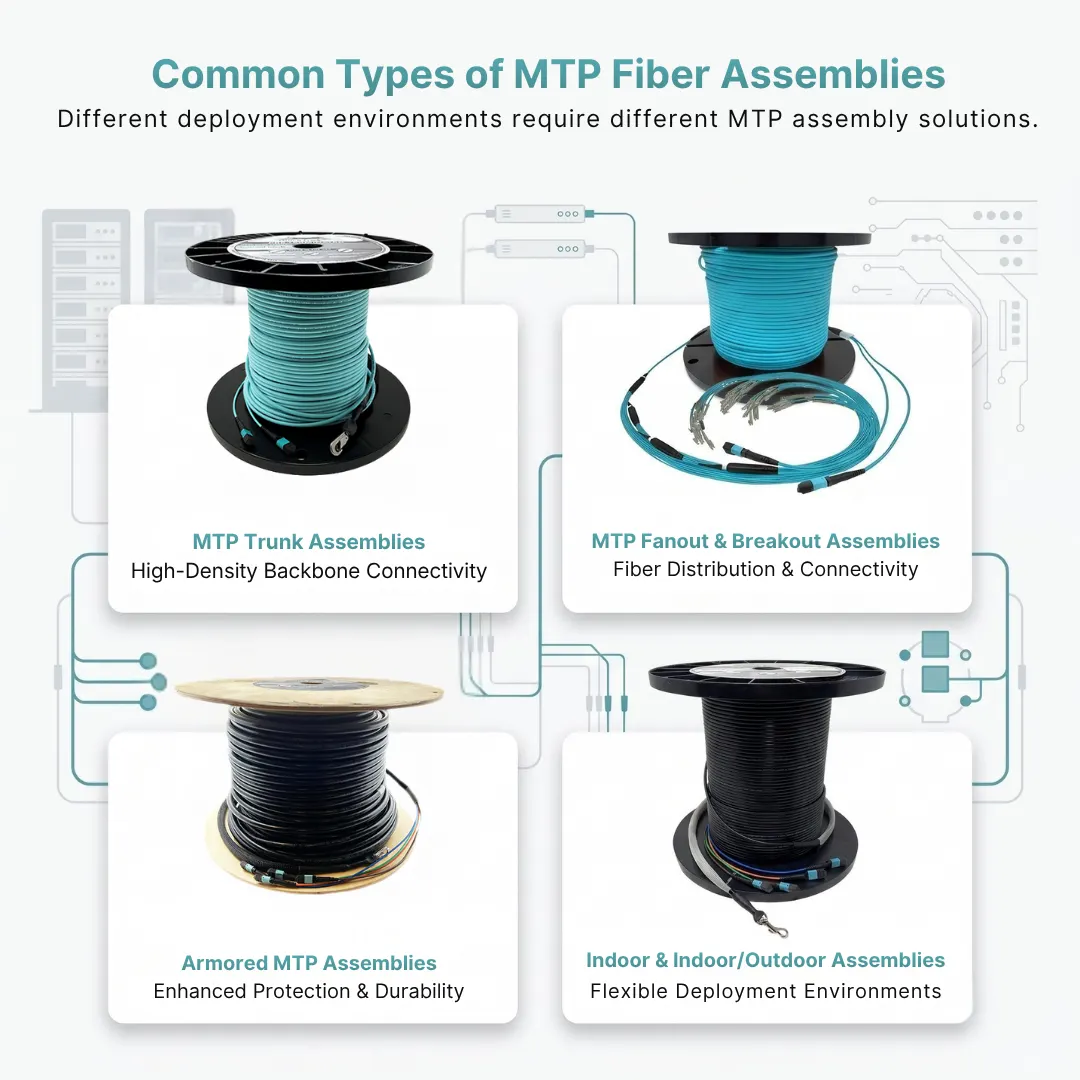
Common Types of MTP Fiber Assemblies
Different deployment environments often require different MTP fiber assembly types.
MTP Trunk Assemblies
Used to support high-density backbone connectivity between racks, cabinets, and network zones.
Common in:
- data centers
- enterprise backbone infrastructure
- telecom environments
MTP Fanout & Breakout Assemblies
Designed to transition high-density fiber connections into smaller distribution points.
Often used for:
- switch connectivity
- patching environments
- transceiver connections
Indoor & Indoor/Outdoor MTP Assemblies
Organizations often choose assembly types based on:
- installation environment
- durability needs
- deployment flexibility
Armored MTP Fiber Assemblies
Selected for environments requiring additional cable protection and physical durability.
Where MTP Fiber Assemblies Are Used
MTP fiber assemblies are commonly deployed in environments requiring high bandwidth, organized cable management, and scalable infrastructure.
Data Centers
For rack-to-rack connectivity and high-density network growth.
Telecommunications Networks
For backbone fiber connectivity and high-capacity environments.
Enterprise Networks
For scalable backbone and campus infrastructure.
Cloud & AI Environments
For high-speed, low-latency connectivity.
Common Mistakes When Choosing MTP Fiber Assemblies
Choosing the Wrong Fiber Type
Singlemode and multimode assemblies are designed for different deployment needs.
Underestimating Fiber Count Requirements
Selecting too few fibers may limit future scalability.
Ignoring Deployment Environment
Indoor, outdoor, and armored assemblies are designed for different conditions.
Overlooking MTP/MPO Polarity
Incorrect polarity planning may create connectivity issues during deployment.
Learn how polarity planning impacts multi-fiber connectivityHow to Choose the Right MTP Fiber Assembly
Before deployment, network teams often evaluate:
- fiber count requirements
- singlemode vs multimode needs
- deployment environment
- durability requirements
- future scalability goals
- polarity requirements
Choosing the right MTP fiber assembly early can help simplify installation while supporting long-term infrastructure growth.
Once you understand the connector, learn how to select the right backbone assemblyFrequently asked questions
Q1: What is an MTP cable?
An MTP cable is a high-density fiber optic assembly that uses MTP® connectors to support multiple fiber strands through a single connection interface for scalable fiber connectivity.
Q2: What is the difference between MTP and MPO?
MTP is a premium MPO connector developed by US Conec with performance enhancements such as improved alignment, lower insertion loss, and better durability.
Q3: What are MTP fiber assemblies used for?
MTP fiber assemblies are commonly used for:
- data center connectivity
- enterprise backbone infrastructure
- telecom networks
- cloud and AI environments
- high-density fiber deployments
Q4: Are MTP assemblies available in singlemode and multimode?
Yes. MTP fiber assemblies are available in both singlemode and multimode configurations, depending on transmission distance and deployment requirements.
Q5: What fiber counts are available in MTP assemblies?
Depending on infrastructure requirements, MTP fiber assemblies may range from 12-fiber to 288-fiber high-density configurations.
Q6: Why do organizations use pre-terminated MTP assemblies?
Pre-terminated MTP assemblies can help reduce installation time, simplify cable management, and improve deployment consistency through factory-tested fiber connectivity.