


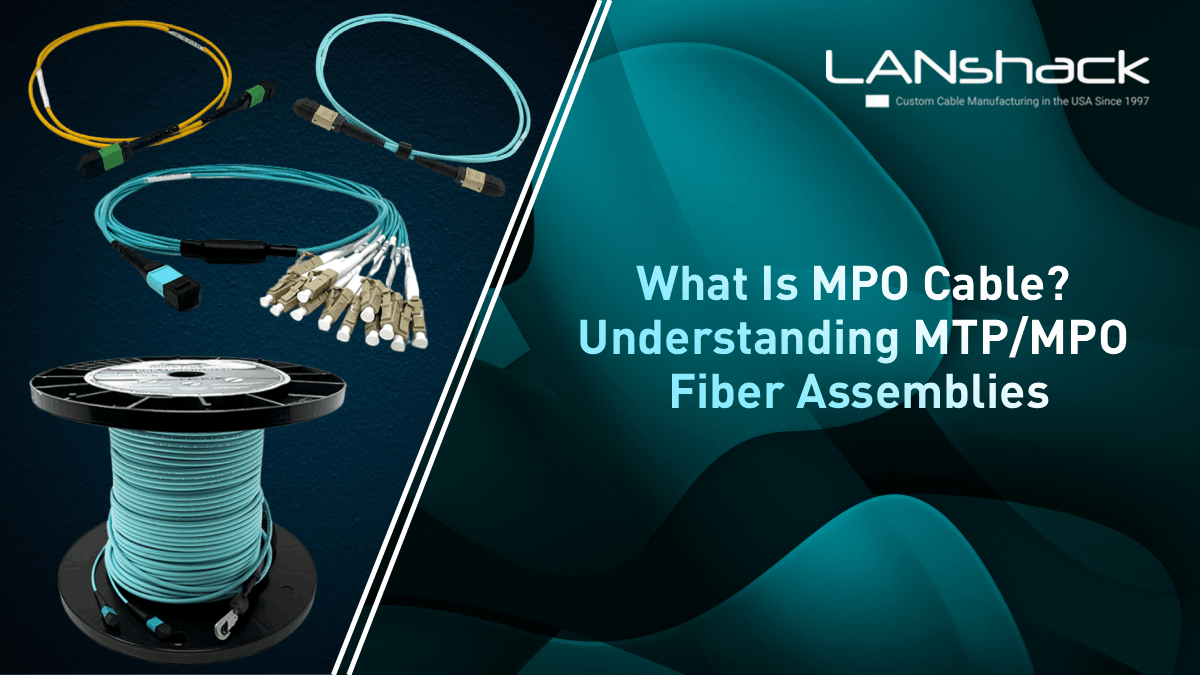


An MPO (Multi-Fiber Push-On) cable is a high-density fiber optic connectivity system that carries multiple fiber strands through a single connector interface, helping simplify large-scale fiber deployments and support higher bandwidth requirements.
In modern environments, MPO connectivity is commonly deployed through pre-terminated MTP/MPO trunk assemblies, where multiple fibers are factory-terminated into MTP or MPO connectors for faster installation, simplified cable management, and scalable high-density networking.
Depending on deployment requirements, MTP/MPO trunk assemblies may range from 12-fiber systems to 144+ and 288-fiber backbone configurations used in enterprise, telecom, cloud, and mission-critical environments.
MPO Cable at a Glance
| Feature | MTP/MPO Fiber Systems |
| Primary Purpose | High-density fiber connectivity |
| Connector Types | MPO & MTP® |
| Typical Fiber Counts | 12F, 24F, 48F, 72F, 96F, 144F, 288F |
| Fiber Types | Singlemode & Multimode |
| Common Formats | Trunk assemblies, fanouts, breakout systems, cassettes |
| Typical Deployments | Data centers, telecom, enterprise backbone infrastructure |
| Key Benefit | Faster deployment with scalable fiber density |
What Is MPO Cable?
At a basic level, an MPO cable is a fiber optic connectivity system designed to support multiple optical fibers through a single high-density connector.
Instead of managing many separate fiber connections, organizations can consolidate multiple fibers into one organized system to simplify installation and support growing bandwidth requirements.
In practice, MPO connectivity is most commonly used through pre-terminated MTP/MPO trunk assemblies, where fiber strands are factory-terminated, tested, and prepared for faster deployment.
This approach helps network teams:
- reduce cable congestion
- simplify backbone deployment
- improve installation consistency
- support future scalability
- speed up deployment timelines
 Many high-density fiber deployments use MTP instead of standard MPO. Why?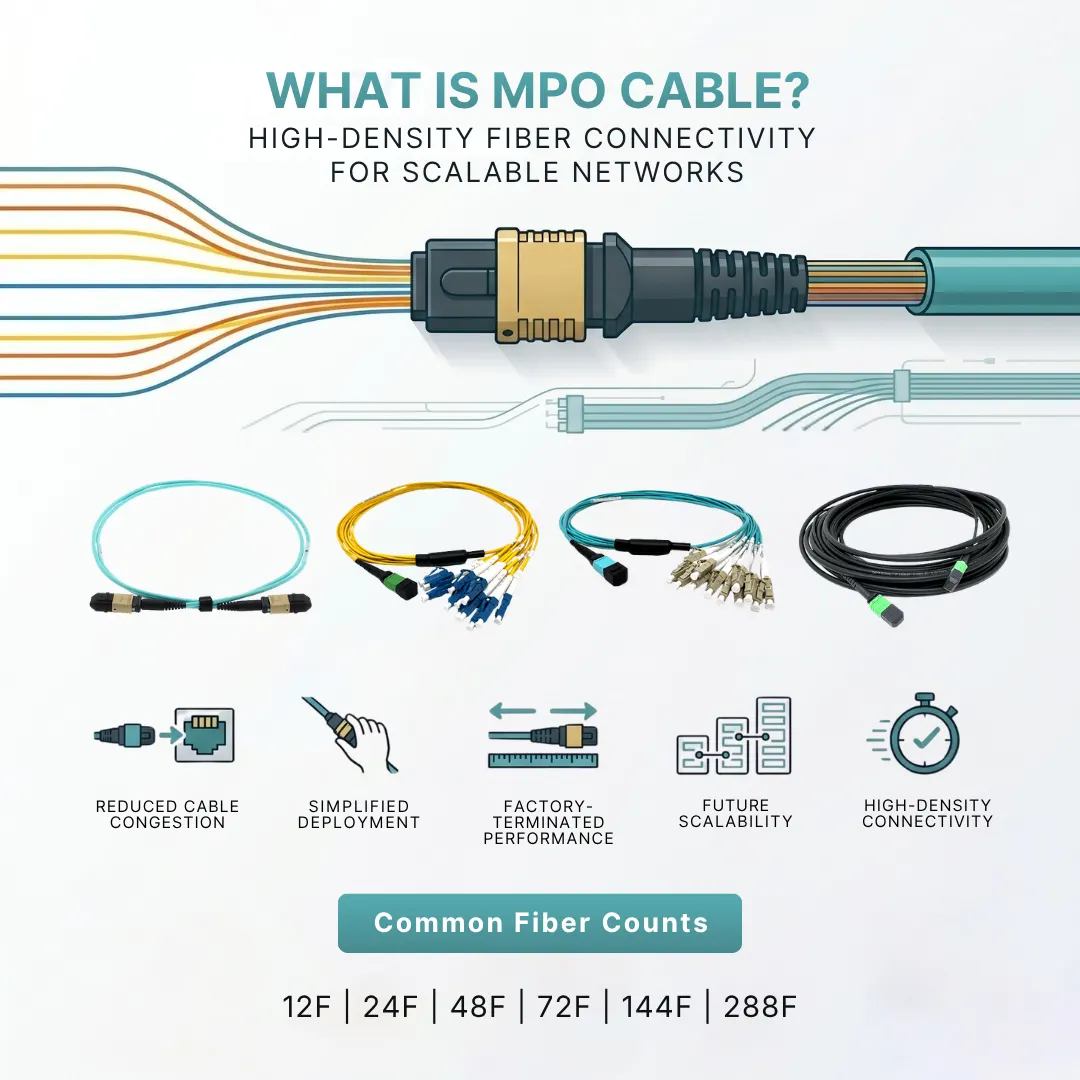
MPO vs MTP: What's the Difference?
Although the terms are often used interchangeably, MPO and MTP are not exactly the same thing.
MPO (Multi-Fiber Push-On)
MPO is the industry-standard connector format designed to support multiple fibers in one high-density connection.
MTP®
MTP is a premium MPO connector developed by US Conec with enhancements such as:
- improved alignment
- lower insertion loss
- better durability
- easier handling during deployment
In simple terms:
MTP is an enhanced version of an MPO connector, while both support high-density fiber connectivity.
Many enterprise and data center deployments choose MTP-based trunk assemblies for improved performance and reliability.
Design, Performance, and Deployment: MTP® vs MPOHow MTP/MPO Trunk Assemblies Work
In high-density environments, organizations typically deploy pre-terminated MTP/MPO trunk assemblies instead of many individual fiber runs.
A trunk assembly combines:
- multiple fiber strands inside one cable
- factory-terminated MTP or MPO connectors
- pre-tested plug-and-play deployment
Instead of manually terminating many separate fiber links, technicians can install a ready-to-deploy trunk assembly designed to simplify backbone connectivity.
Simple Example
A data center connecting multiple racks may use a single MTP/MPO trunk assembly instead of dozens of individual fiber cables, reducing installation complexity and cable congestion.
Common MTP/MPO Trunk Configurations
Different environments require different fiber-count configurations.
| Fiber Count | Common Use Case |
| 12F | Smaller backbone runs and point-to-point links |
| 24F | Enterprise backbone growth |
| 48F | Higher-density aggregation |
| 72F | Data center backbone infrastructure |
| 96F | Large-scale fiber distribution |
| 144F | Enterprise and telecom high-density environments |
| 288F | Carrier-grade and hyperscale deployments |
Organizations may also choose between singlemode or multimode assemblies, along with indoor, indoor/outdoor, armored, and specialty constructions.
Planning a Deployment? Learn how fiber counts from 12F to 288F impact scalabilityCommon Types of MTP/MPO Fiber Assemblies
Different deployment environments often require different MTP/MPO assembly types.
Indoor MTP Trunks
Used for:
- data centers
- telecom rooms
- enterprise backbone systems
Indoor/Outdoor Trunk Assemblies
Often selected for:
- campus infrastructure
- building-to-building connectivity
- mixed environments
Armored MTP Trunks
Designed for environments requiring additional cable protection.
MTP Fanouts & Breakout Assemblies
Help transition high-density trunks into smaller fiber connections.
MPO Cassettes & Enclosures
Used to organize and distribute fiber connectivity in structured environments.
Singlemode vs Multimode MTP/MPO Assemblies
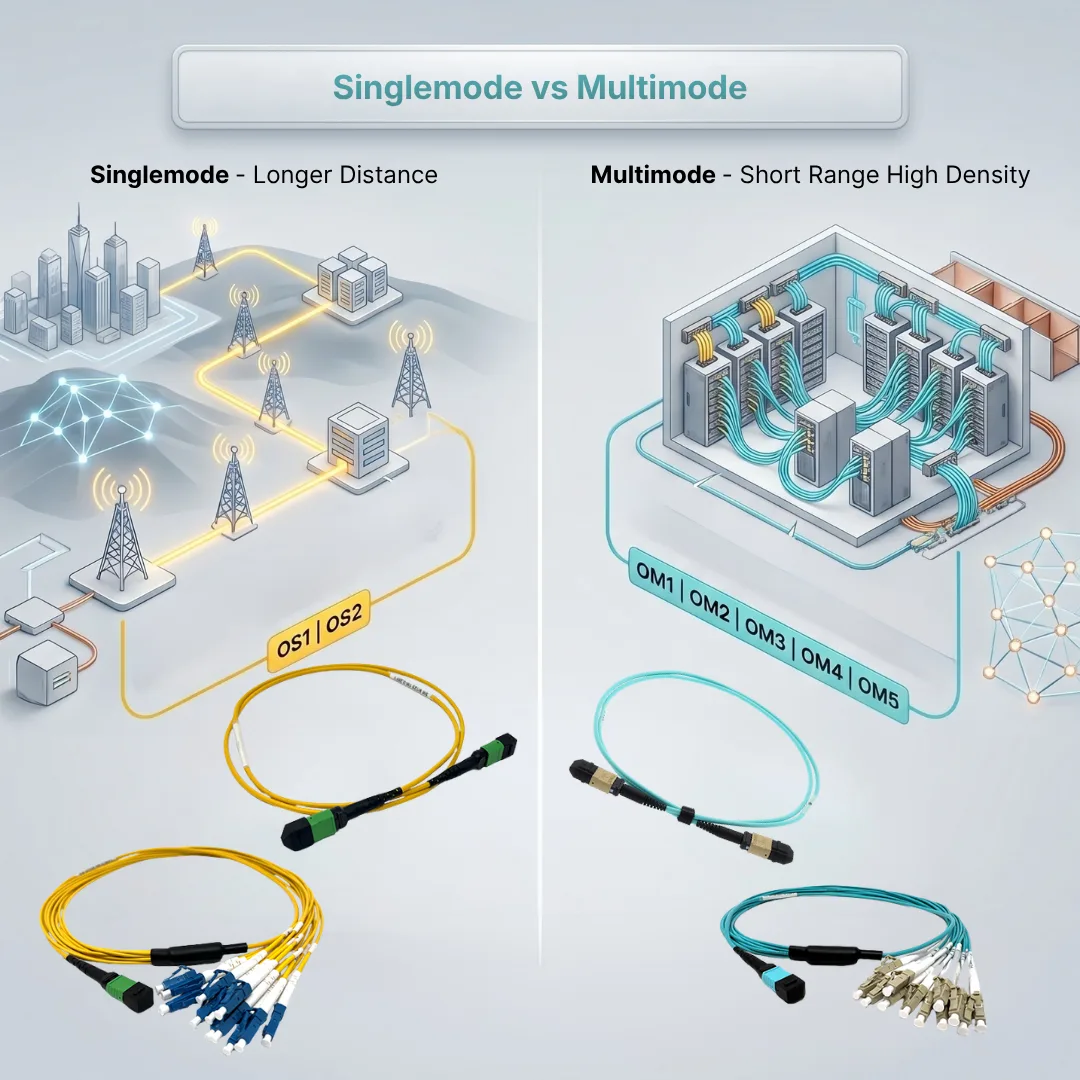
Choosing between singlemode and multimode assemblies depends mainly on transmission distance and deployment needs.
| Fiber Type | Best For |
| Singlemode | Longer-distance backbone infrastructure |
| Multimode | Short-range, high-density internal connectivity |
In many deployments, singlemode is used for longer distances, while multimode supports shorter high-density environments such as rack-to-rack connections.
Where MTP/MPO Systems Are Used
MTP/MPO fiber assemblies are commonly deployed in environments requiring high bandwidth, scalability, and organized fiber management.
Data Centers & Cloud Infrastructure
For high-density rack-to-rack connectivity and scalable network growth.
Telecommunications Networks
For backbone connectivity and high-capacity transmission environments.
Enterprise & Campus Networks
For building-to-building fiber and backbone infrastructure.
AI & High-Performance Computing
For low-latency, high-bandwidth data movement.
Government & Mission-Critical Environments
For reliable, scalable network infrastructure.
Common Mistakes When Choosing MTP/MPO Systems
Choosing the Wrong Fiber Type
Singlemode and multimode are designed for different deployment needs.
Underestimating Fiber Count
Too few fibers may limit future scalability.
Ignoring Deployment Environment
Indoor, outdoor, and armored assemblies are built for different conditions.
Overlooking Polarity Requirements
Incorrect polarity selection can create connectivity issues.
Understand MTP/MPO Polarity Before DeploymentHow to Choose the Right MTP/MPO Assembly
Before deployment, network teams often evaluate:
- fiber count requirements
- singlemode vs multimode needs
- indoor vs outdoor environment
- durability requirements
- future scalability goals
- polarity requirements
For many high-density environments, choosing the right pre-terminated MTP/MPO trunk assembly early can simplify future upgrades and reduce deployment complexity.
Frequently asked questions
Q1: What does MPO stand for?
MPO stands for Multi-Fiber Push-On, a connector format designed for high-density fiber connectivity.
Q2: What is the difference between MPO and MTP?
MTP is a premium MPO connector developed by US Conec with performance enhancements.
Q3: What is an MPO trunk cable?
An MPO trunk cable is a pre-terminated fiber assembly designed to support multiple fiber connections through a high-density backbone cable.
Q4: What fiber counts are available in MTP/MPO assemblies?
Depending on deployment needs, assemblies may range from 12F to 288F+ configurations.
Q5: Is MPO singlemode or multimode?
MPO systems are available in both singlemode and multimode configurations.
Q6: Where are MTP/MPO fiber assemblies commonly used?
They are widely used in data centers, telecom networks, enterprise backbones, AI infrastructure, and mission-critical environments