




MTP/MPO polarity refers to how optical fibers are aligned between connection points to ensure signals travel correctly from transmit (Tx) to receive (Rx).
In high-density fiber environments, choosing the wrong polarity type can create connectivity issues, installation delays, and troubleshooting challenges.
The three most common polarity methods are:
- Type A (Straight Through)
- Type B (Reversed)
- Type C (Pair-Flipped)
Each polarity type is designed for different deployment requirements depending on network architecture, connector orientation, and fiber routing needs.
MTP/MPO Polarity at a Glance
| Polarity Type | Fiber Mapping | Typical Orientation | Common Use |
| Type A | Straight-through | Key-Up to Key-Down | Structured backbone environments |
| Type B | Fully reversed | Key-Up to Key-Up | 40G/100G parallel optics |
| Type C | Pair-flipped | Pair reversal | Duplex fiber applications |
The right polarity depends on how transmit and receive signals must align across the network.
What Is MTP/MPO Polarity?
At a basic level, MTP/MPO polarity determines how fiber signals travel from one connection point to another.
In fiber networks:
Transmit (Tx) must always connect to Receive (Rx).
If signals are mapped incorrectly, the connection may fail even when the fiber assembly itself is functioning properly.
This is why polarity planning becomes important in high-density MTP/MPO trunk assemblies, especially in environments supporting multiple fibers through one connector.
Rather than troubleshooting problems after installation, many network teams plan polarity early to simplify deployment and reduce configuration issues later.
 If you're new to MPO-based networking, start with What Is MPO Cable?
Why MTP/MPO Polarity Matters
In high-density environments, correct signal alignment is critical.
Choosing the wrong polarity type may result in:
- failed signal transmission
- longer troubleshooting time
- installation delays
- unnecessary reconfiguration
This becomes especially important in:
- high-density MTP/MPO trunk assemblies
- data center backbone deployments
- telecom environments
- high-speed Ethernet applications
Type A Polarity (Straight Through)
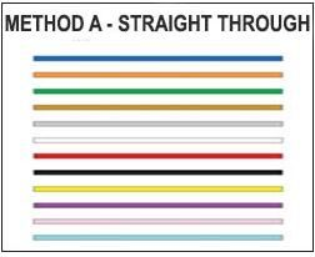
Type A polarity maintains the same fiber position from one end of the trunk assembly to the other.
In simple terms:
Fiber 1 connects to Fiber 1
Type A typically uses:
Key-Up to Key-Down orientation
This polarity type is commonly used in structured cabling and backbone environments where polarity management happens through cassette or patching design.
However, Type A alone does not automatically guarantee Tx-to-Rx alignment. Overall channel design still matters.
Commonly Used For:
- backbone fiber infrastructure
- enterprise environments
- structured cabling systems
Type B Polarity (Reversed)
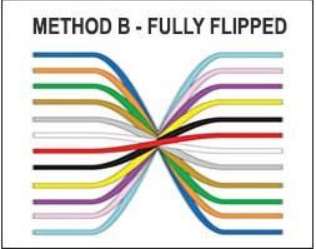
Type B polarity uses a fully reversed fiber mapping between connector ends.
In simple terms:
Fiber positions are reversed across the connector.
Example:
Fiber 1 → Fiber 12
Fiber 2 → Fiber 11
Type B typically uses:
Key-Up to Key-Up orientation
This polarity type is commonly used in:
- 40G and 100G applications
- parallel optics environments
- high-density data center deployments
Because fibers are reversed across the trunk assembly, Type B can help simplify Tx-to-Rx alignment in specific architectures.
Learn how MTP enhances MPO technologyType C Polarity (Pair-Flipped)
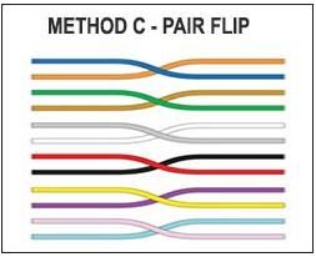
Type C polarity uses pair-wise flipping, where adjacent fiber pairs are reversed instead of reversing the full connector.
Example:
Fiber 1 ↔ Fiber 2
Fiber 3 ↔ Fiber 4
Type C is commonly used in:
- duplex fiber applications
- point-to-point environments
- specific transceiver architectures
Compared to Type B, Type C focuses on reversing fiber pairs rather than the entire connector mapping.
Type A vs Type B vs Type C
| Polarity Type | Fiber Mapping | Typical Orientation | Common Use |
| Type A | Straight-through | Key-Up to Key-Down | Structured cabling |
| Type B | Fully reversed | Key-Up to Key-Up | Parallel optics, 40G/100G |
| Type C | Pair-flipped | Pair reversal | Duplex applications |
The right polarity often depends on:
- network architecture
- transceiver type
- connector orientation
- deployment requirements
- future scalability
What's the difference between connector designs and polarity methods?Common MTP/MPO Polarity Mistakes
Assuming All Trunk Assemblies Use the Same Polarity
Not all MTP/MPO trunk assemblies use the same polarity method.
Using the wrong polarity type may create signal alignment issues even when the fiber assembly itself is functioning correctly.
Ignoring Connector Orientation
Connector orientation matters.
-
Key-Up to Key-Up
-
Key-Up to Key-Down
may affect how fibers align depending on the polarity method being used.
Mixing Polarity Types in One Channel
Using different polarity methods across the same channel may create Tx/Rx mapping problems.
Assuming MTP and MPO Change Polarity Rules
Although MTP and MPO connectors differ in design, polarity principles remain the same.
Skipping End-to-End Validation
Even with pre-terminated assemblies, many teams still validate the full signal path before deployment.
How to Choose the Right MTP/MPO Polarity
Before deployment, network teams often evaluate:
- network architecture
- transceiver requirements
- connector orientation
- fiber routing method
- future scalability needs
Deployment Planning Tip: Fiber count and network architecture often influence polarity requirements.In many environments:
Type A
works well in structured backbone environments.
Type B
is commonly used for 40G and 100G parallel optics applications.
Type C
may be used in duplex applications requiring pair flipping.
Frequently asked questions
Q1: What is MTP/MPO polarity?
MTP/MPO polarity refers to how fiber signals align between connection points to ensure Transmit (Tx) correctly reaches Receive (Rx).
Q2: What is the difference between Type A and Type B MPO polarity?
Type A uses straight-through fiber mapping.
Type B uses fully reversed fiber mapping and is commonly used in parallel optics environments.
Q3: What is Type C polarity?
Type C polarity uses pair-wise fiber reversal, where adjacent fiber pairs are flipped instead of reversing the full connector.
Q4: Which polarity is used for 40G and 100G?
Many 40G and 100G parallel optics environments commonly use Type B polarity, although deployment architecture still matters.
Q5: Does MTP vs MPO affect polarity?
No. Polarity principles remain the same for both MTP and MPO connectivity.
Q6: Can polarity mistakes cause connectivity problems?
Yes. Incorrect polarity may prevent signals from reaching the intended destination even when hardware is functioning properly.